Espilon
Hardware, IoT and OT security research. ESP32, embedded protocols, CTF write-ups.
The card reader bolted to the wall outside your building is the part nobody trusts. That is exactly why the protocol lets it talk to the panel inside. Two missing bounds checks turn that reply channel into a memory-corruption primitive against the controller that unlocks the door. TL;DR Two flaws in LibOSDP, the cross-platform C implementation of OSDP, the protocol behind most modern badge readers. Same root cause on two sides of the bus: a length taken off the wire and trusted against a fixed-size destination. ...
Found this at 2 AM, reading ESP-TEE source I had no business reading. One line looked off. It was off by a single character. That character had re-opened a CVSS 9.3, inside the fix meant to close it. TL;DR Two sibling flaws in the ESP-TEE secure-service wrappers. Same code, opposite primitives. The write (CVE-2026-45328, CVSS 9.3 critical, CVSS:3.1/AV:L/AC:L/PR:N/UI:N/S:C/C:H/I:H/A:H; the C:H term is the chained worst case, see the impact section). Its root cause is incomplete pointer validation. Espressif fixed it, then one omitted commit re-opened the write in v6.0.1: a single character, = instead of &= inside _ss_esp_tee_sec_storage_aead_encrypt(), dead-stores the five-term pointer-validation chain the moment aad_len != 0. A REE app points the iv argument into TEE M-mode memory; the TEE then calls esp_fill_random(iv, iv_len) before the AEAD body runs, writing attacker-length random bytes to the attacker-chosen TEE address. ...
Some bugs hide behind clever exploitation. This one is a memcpy with no length check, reachable before authentication, from any BLE radio in range. TL;DR CVE-2026-47773 (GHSA-77v6-cw9f-9whg). A missing bounds check in ArduinoBLE’s ATT write-request handler. When a client writes to a characteristic that requires encryption (the BLEEncryption permission) but the link is not yet AES-encrypted, ArduinoBLE stashes the pending write into a fixed 64-byte writeBuffer inside the global ATTClass object, to replay it once encryption is up. It copies the attacker-supplied value into that buffer with no length check. ...
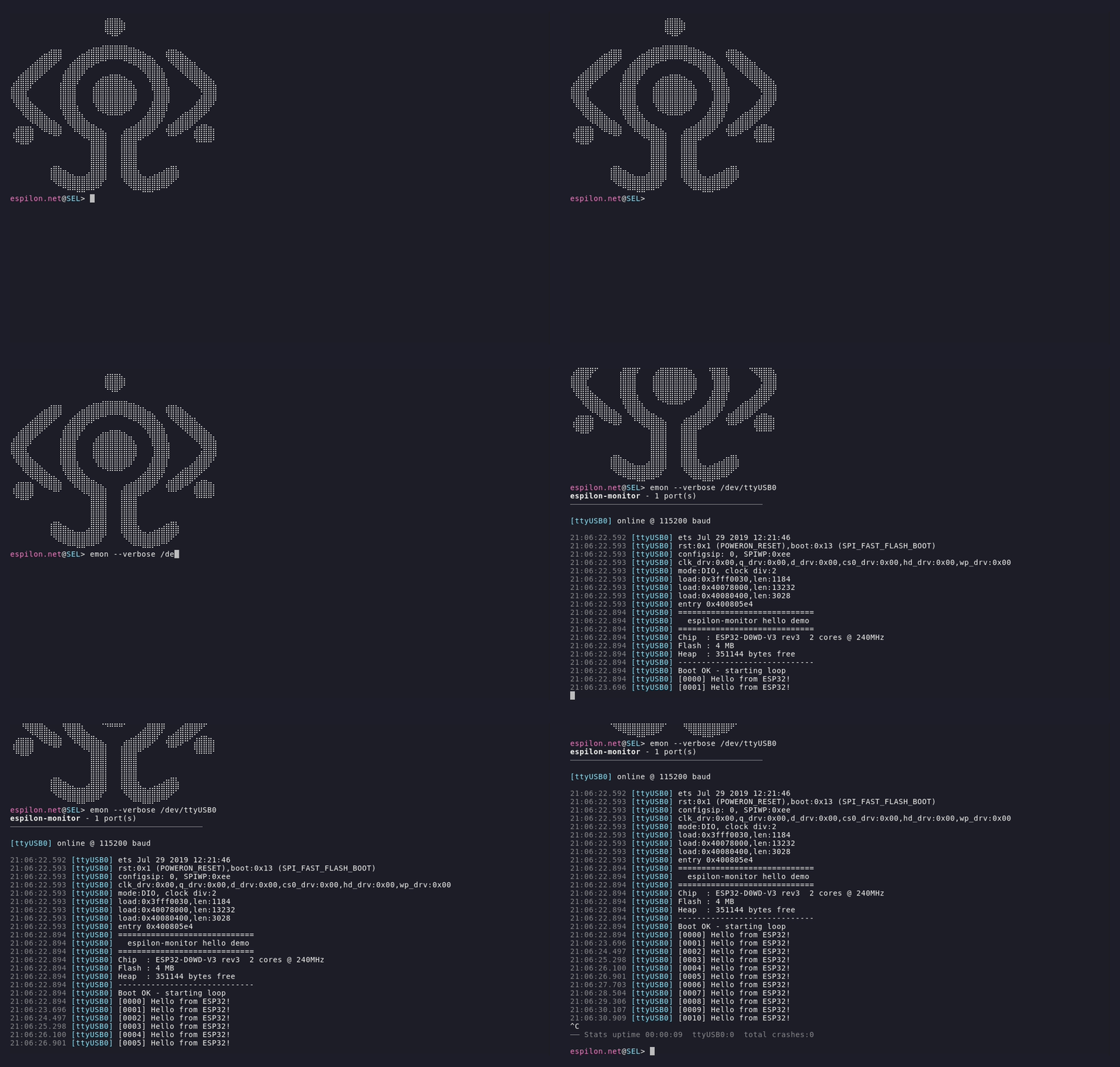
Why another serial monitor? screen, minicom, picocom all do the same thing: open a port, show bytes, let you type. That works fine for a quick debug session. It breaks the moment you want to automate anything. No scripting. No pattern detection. No structured output. One port at a time. No exit code based on what the device prints. emon is built around the idea that serial output is structured data, not just text. If your device speaks UART (ESP32, STM32, Arduino, Raspberry Pi, a custom FPGA board, an industrial PLC, a GSM modem), emon works with it out of the box. It watches for patterns, fires hooks, streams JSON, and integrates directly into CI pipelines. ...